



Life’s Great Paradoxes: The Hidden Truths Behind Freedom, Success, and Happiness
The Reverse Laws of Life
Everything that truly matters in life seems to operate backward. The harder you chase happiness, the more elusive it becomes. The faster you rush toward success, the more likely you are to stumble. The more you demand freedom without responsibility, the more enslaved you feel. These are not coincidences — they are paradoxes, the quiet laws of life that run in reverse.
Think about it: we live in an age obsessed with control, speed, and optimisation. Yet the people who thrive aren’t necessarily the ones who push hardest — they are the ones who understand when to let go. The musician who practices daily is freer than the one who plays only when “inspired.” The athlete who trains deliberately moves faster than the one constantly sprinting. The happiest people aren’t those chasing euphoria but those who have learned to sit comfortably with discomfort.
Life’s great truths often hide in contradiction. Paradoxes force us to see the other side of the coin — the side that logic overlooks but experience always confirms. Understanding them requires humility. Living them requires courage.
In this exploration, we’ll walk through the great paradoxes that govern freedom, speed, success, focus, happiness, knowledge, strength, and fear. You’ll discover why doing the opposite of what seems right often leads to what you’ve been seeking all along. These ideas aren’t abstract philosophy; they’re survival skills for a modern mind overloaded with noise and craving meaning.
Welcome to the hidden logic of life — where forward often means backward, and the path to mastery begins with unlearning everything you thought you knew.
Freedom Paradox: Discipline Is the Real Liberation
We think freedom means having no rules. No schedules. No constraints. The dream, right? To wake up and do whatever we want, whenever we want. But when you actually live that way — when you try to be “unbound” — something strange happens. You don’t feel free. You feel restless, anxious, and strangely trapped.
Why? Because freedom without structure turns into chaos.
The law of life runs in reverse: unbound, you become a slave to impulse and indecision.
Think of the writer who waits for inspiration to strike — they rarely write. But the one who commits to sitting down every morning, whether inspired or not, eventually produces their best work. The same goes for musicians, athletes, or entrepreneurs. True freedom lies not in doing whatever you want but in doing what you choose — consistently.
Discipline is not the opposite of freedom; it’s the foundation of it. When you define your boundaries, you stop wasting energy on trivial decisions. You create clarity. You give your mind and spirit room to expand.
Eliud Kipchoge, the world’s greatest marathoner, captured it perfectly: “Only the disciplined ones in life are free. If you are undisciplined, you are a slave to your moods and passions.” Freedom isn’t about escaping order; it’s about mastering it so deeply that it becomes second nature.
When you live by self-imposed rules, you are no longer at the mercy of your moods or distractions. The rules you set for yourself are what set you free.
Practiced Freedom: Routine as a Path to Expression
Here’s the irony — structure, which seems restrictive, is what makes expression possible. The musician who practices scales daily gains the fluency to improvise freely. The dancer who repeats the same movements for hours develops grace that looks effortless. The writer who commits to a fixed schedule gains a voice that flows like water. Freedom isn’t about escaping repetition; it’s about refining it until it becomes art.
Routine is your anchor in chaos. It’s what keeps you from being tossed around by every impulse or distraction. Once your craft becomes ritual, it liberates your mind to create without friction.
Real artists know this: practice isn’t punishment. It’s the path. Without the grind, creativity is just chaos dressed up as genius. The paradox of freedom is that you earn it through devotion.
That’s why structure isn’t something to fear — it’s something to design with intention. Your habits are not handcuffs; they are flight patterns. The deeper your discipline, the higher your freedom.
Speed Paradox: Slow Is Smooth, Smooth Is Fast
Modern life worships speed. We want instant results, instant feedback, instant success. “Move fast and break things,” we say — as if momentum alone guarantees victory. But speed without precision isn’t progress. It’s panic.
When we rush, we skip the small details that make a big difference. We overreact. We make sloppy moves that create more work later. What’s faster in the moment becomes slower in the long run. The law of life runs in reverse: true speed is deliberate. It is the absence of frantic energy.
It’s the surgeon’s calm hand. The driver’s steady focus in a storm. The athlete who slows down to move efficiently.
Mitsuyo Maeda said it best: “Slow is smooth, smooth is fast.” When your actions are smooth — not rushed, but clean and steady — everything compounds. You get faster because you stop wasting time fixing mistakes born of haste.
The fastest way to move forward in life is to stop sprinting mindlessly and start walking intentionally. Smoothness, not speed, is the real advantage.
Success Paradox: Subtraction Over Addition
We live in a culture obsessed with success formulas. Everyone’s trying to perfect their morning routine, optimize their productivity systems, or copy the habits of billionaires. We think success is about adding more — more effort, more strategies, more hustle. But the law of success runs in reverse: you succeed not by doing more, but by doing less — by avoiding stupidity, not chasing brilliance.
This idea isn’t just philosophical; it’s practical. Charlie Munger, one of the wisest investors of our age, once said, “Tell me where I’m going to die, so I’ll never go there.” Instead of asking, “What should I do to win?”, Munger asks, “What should I avoid so I don’t lose?”
The truth is, success is often a process of elimination. You remove distractions, bad habits, poor decisions, and toxic influences — and what remains naturally rises. You don’t need to be a genius; you just need to stop doing dumb things consistently.
The paradox is this: by focusing less on perfection and more on avoiding pitfalls, you quietly build unstoppable momentum. The compound effect of not making major errors over decades outpaces any flash of brilliance.
Success, then, is not about intensity — it’s about consistency. The greatest advantage isn’t in trying to be very intelligent; it’s in being consistently not stupid. And that’s the quiet art of winning.
Focus Paradox: The Intelligence to Exclude
We glorify multitasking. We treat focus like a muscle — something we can strain and expand endlessly. We want to do more, learn more, and master everything. But the more we chase expansion, the less depth we achieve. The paradox of focus is simple: when everything matters, nothing does.
Human cognition has limits. Our attention is a narrow beam, not a floodlight. When you try to shine it on everything, the brightness fades. Deep focus doesn’t come from willpower — it comes from selection.
Focus isn’t about doing more; it’s about deciding what to ignore. It’s the intelligence to exclude. Every “yes” you give is a “no” to something else, and saying “no” is an act of creative power.
Steve Jobs understood this better than most. He said, “Focus is about saying no.” Apple’s legendary simplicity didn’t emerge from doing everything right — it came from stripping away everything unnecessary. That same principle applies to life: greatness comes from subtraction.
To live focused is to live intentionally. It’s not a matter of working harder, but of protecting your bandwidth from noise. Focus is not strain — it’s serenity through clarity.
Happiness Paradox: The Chase That Kills Joy
Happiness might be the most misunderstood goal in human history. Everyone wants it, yet the more we chase it, the further it drifts. The fundamental paradox is this: the direct pursuit of happiness pushes it away.
The tighter you grasp it, the faster it slips through your fingers. Why? Because happiness isn’t something you seize — it’s something that ensues. It’s the by-product of living meaningfully, not the result of chasing pleasure.
The more you fixate on being happy, the more anxious you become about not feeling happy enough. It turns into an emotional treadmill that never stops. The cure? Acceptance. Letting yourself feel what you feel, instead of policing your emotions.
Alan Watts described this perfectly: “When you try to stay on the surface of the water, you sink; but when you try to sink, you float.” In other words, when you stop resisting sadness or anxiety, they lose their grip. Paradoxically, the freedom to be anxious is what makes you calm.
Happiness, like a shadow, follows you when you stop chasing it. Focus on meaning, connection, and contribution — and joy will quietly meet you there.
Knowledge Paradox: The More You Know, the Less You’re Certain
Knowledge is supposed to bring confidence, but in truth, it often breeds humility. The first-year student reads one book and thinks they can fix the world. The Nobel laureate, after a lifetime of study, is humbled by how little they truly understand. This is known as the Dunning-Kruger effect — the blindness of the beginner who mistakes limited knowledge for mastery. The paradox here is simple: the more you know, the clearer you see how little you know.
Certainty is the enemy of wisdom. Real intelligence isn’t loud; it’s quiet, cautious, always questioning. As Mark Twain once said, “It ain’t what you don’t know that gets you into trouble. It’s what you know for sure that just ain’t so.” In an age where everyone has an opinion, humility becomes a superpower. The wise don’t rush to declare — they pause to understand. They don’t cling to being right; they remain open to being wrong.
Knowledge, then, is not a possession. It’s a practice — a constant process of unlearning, refining, and deepening. Wisdom lives in the space between certainty and curiosity.
Strength Paradox: Fragility in Rigidity
We often mistake strength for hardness. We think to be strong means to be unbreakable, untouchable, immune to pain. But rigidity is the first thing to crack under pressure. True strength is not resistance; it’s resilience.
The paradox of strength lies in flexibility. The rigid wall shatters when struck; the tree that bends in the storm survives. Real strength doesn’t avoid stress — it metabolises it.
This is what author Nassim Nicholas Taleb calls Anti-fragility — the ability not just to withstand shocks but to grow stronger because of them. “The resilient resists shocks and stays the same; the anti-fragile gets stronger from it,” he wrote.
So, the truly strong person isn’t the one who avoids chaos but the one who transforms it. They don’t deny struggle — they digest it. Every setback becomes data. Every wound becomes wisdom.
In a world obsessed with appearing “tough,” the paradox is that softness — adaptability, openness — is the ultimate strength. To be strong is not to resist life’s blows but to evolve with them.
Fear Paradox: Freedom Through Confrontation
Fear is primal. It evolved to protect us from danger. But in our modern lives, that same instinct often betrays us. We fear judgment, failure, change — things that won’t kill us but still feel deadly. The paradox of fear is this: what we run from grows stronger; what we face fades away.
Avoidance is fuel. Every time we dodge a fear, we reinforce it. What starts as a shadow grows into a monster. But when we turn toward it, look it in the eye, it begins to dissolve. Fear cannot survive contact with awareness.
J. Krishnamurti said it with profound simplicity: “What is needed, rather than running away or suppressing fear, is understanding it — watching it, learning about it, coming directly into contact with it.”
Facing fear isn’t about eliminating it; it’s about embracing it. The moment you stop trying to suppress your fear, you gain power over it. The act of observing dissolves its control. Courage, then, isn’t the absence of fear — it’s the mastery of it through understanding.
Integrating the Paradoxes: The Map of Reverse Wisdom
When you look at all these paradoxes together, a deeper pattern emerges. Every domain of life — freedom, speed, success, focus, happiness, knowledge, strength, fear — follows the same law: the straight path rarely leads straight.
To move forward, you often have to pause. To win, you must stop striving. To understand, you must doubt. To find peace, you must allow chaos. The opposites aren’t enemies — they’re partners in balance.
Once you see this pattern, life becomes less of a struggle and more of a dance. You stop resisting contradiction and start using it. That’s where true wisdom begins.
Practical Framework: Living by Reverse Laws
Here’s how to practice paradoxical wisdom daily
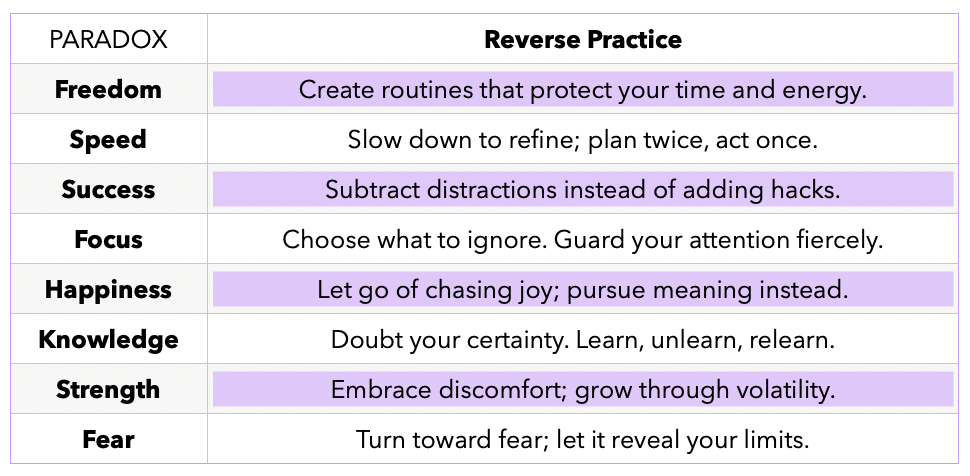
Practice these inversions for 30 days and observe how your mindset shifts. You’ll begin to see how freedom, success, and happiness flow naturally when you stop chasing them directly.
Common Mistakes When Applying Paradoxes
Overcorrecting into rigidity. Balance discipline with flexibility.
Confusing slowness with procrastination. Slow doesn’t mean lazy — it means intentional.
Mistaking “no” for negativity. Saying no creates room for higher priorities.
Romanticising struggle. The goal isn’t to suffer, but to grow through difficulty.
Seeing the World Backward to Move Forward
In conclusion, life is not a straight line — it’s a spiral. Every lesson brings you back to where you started, but with greater understanding. The great paradoxes remind us that truth lives in tension, not extremes.
Freedom is found in discipline. Success in simplicity. Strength in surrender. And happiness in letting go.
When you stop fighting life’s reversals and start flowing with them, you begin to live intelligently — not by forcing, but by aligning.
Everything that matters in life is a paradox — and that’s the point. The laws of life run in reverse because they’re designed to teach you balance. Master that, and you master everything.
FAQs
1. What is a life paradox?
A life paradox is a truth that seems contradictory but reveals deeper wisdom — like finding freedom through discipline or happiness through acceptance.
2. How can embracing paradoxes improve decision-making?
It teaches balance. Instead of chasing one extreme, you learn to harmonise opposites — action with patience, strength with softness, logic with emotion.
3. Can these paradoxes apply to business or creativity?
Absolutely. The most effective leaders, creators, and thinkers succeed by applying these reversals — slowing down to go faster, simplifying to scale.
4. Why do the “laws of life” run backward?
Because the human mind seeks control, but life thrives on flow. What feels intuitive often creates resistance; what feels counterintuitive creates results.
5. How can one begin living by these paradoxical principles today?
Start by observing your reactions. When you feel the urge to rush, pause. When you want control, release. When you want comfort, lean into challenge. Practice inversion daily — and you’ll find life unfolding in new harmony.
Written by AnneMie Decatte
Founder of The Life Strategist Co — helping individuals reclaim clarity, confidence, and choice in every area of life.
Read more at: www.thelifestrategist.com
Follow on Instagram: @the_life_strategist
The Life Strategist Copyright © 2025